Esec
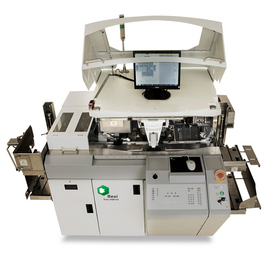
Esec 2100 hS iXplus
Wafer size
4"
Performance
20 µm @ 3σ (15 µm option)[1]
What it is
The Esec 2100 hS is the third generation of a flexible 300 mm high-speed platform, designed to run an extensive range of epoxy die attach applications. At its introduction, this platform concept won the Swiss Technology Award.[1]
How it works
The Esec 2100 hS uses a revolutionary Phi-Y concept that combines rotational and linear movements to achieve a very short pick-and-place cycle time. A new lightweight and rigid pick-and-place structure, advanced trajectory control, and a liquid cooling system ensure excellent accuracy at high speed.[1]
Real-time process monitoring is provided through four live images of the process zone, and constant status control is available via real-time wafer, strip, and magazine viewers. The machine uses new controller hardware with Gigabit Ethernet communication to enable advanced processes.[1]
Where it fits in the process flow
General reference — not yet source-verifiedIn semiconductor packaging, the die bonder receives singulated dies from a wafer dicing process and attaches them to a substrate or leadframe. The assembled substrate then proceeds to wire bonding, flip-chip interconnection, or other bonding steps, followed by encapsulation and trim/form operations.
Applications
The machine accommodates wafer sizes from 4 inches to 12 inches (on 8-inch or 12-inch wafer frames) and die sizes from a minimum of 0.25 mm (with a Small Die Kit) up to 20 mm. Placement accuracy is 20 µm at 3 sigma, with an optional 15 µm High Accuracy Mode.[1]
- TSOP
- FBGA
What do the numbers mean?
Wafer handling2
Performance1
Dimensions & facilities2
Configuration & options4
Where are the manuals?
Generated from public-source data on file. Enter your email to access — nothing is published; details are routed privately.
Not publicly documented
Field notes
No research found yet — worked with this tool? Share what you know.
Not publicly documented
The following facts about the Esec 2100 hS iXplus are absent from this record as of this revision. First-hand knowledge or a citation closes a gap; every submission is reviewed before publication.
No publicly documented production dates or lifecycle milestones (introduction, end of production, EOL) for the Esec 2100 hS iXplus are on record.
Answerable by: OEM historical records or a trade-press announcement
No publicly documented variants, configuration options, or revision breakpoints of the Esec 2100 hS iXplus are on record.
Answerable by: an OEM product catalog or an engineer who ordered or specified the tool
The control-system platform and OS era of the Esec 2100 hS iXplus are not on record.
Answerable by: an engineer who operated it or OEM installation records
No publicly documented failure modes or field errata for the Esec 2100 hS iXplus are on record.
Answerable by: a field service engineer, process engineer, or maintenance technician
The process node or technology generation of the Esec 2100 hS iXplus is not on record.
Answerable by: an OEM datasheet or a fab qualification report
No research found yet — worked with this tool? Share what you know.
Sources & citations
Sources (3)Every fact above is drawn from these public sources
- [1]besi.com — besi.combesi.com
- [2]Inventory photo
- [3]Inventory photo
Last updated Oct 10, 2026.
Compare with similar tools
View all →The Esec 2009 fS E is an epoxy die bonder for 300 mm high-speed die attach applications. The Esec 2009 fS E supports wafer sizes from 4" to 12" on 8" or 12" wafer frames.
The Esec 2100 hS i is a die bonder for epoxy die attach applications. The Esec 2100 hS i is a 300 mm high-speed platform with support for wafer sizes from 4 inches to 12 inches on 8-inch or 12-inch wafer frames.
The Esec 2100 sD advanced i is a die bonder for epoxy die attach applications. The Esec 2100 sD advanced i is described as a 3rd generation 300 mm high speed platform with 20 µm bonding accuracy and an optional 15 µm placement accuracy in High Accuracy Mode.

The MRSI 505 Die Attach is a packaging and bonding machine for semiconductor assembly, used for die attach and multichip module work.
The Datacon 2200 evo is a die bonder for epoxy die attach applications.
The Esec Datacon 2200 evo advanced is a die bonder for epoxy die attach applications. The Esec Datacon 2200 evo advanced is described as a flexible 300 mm high-speed platform with wafer sizes from 4 inches to 12 inches on 8-inch or 12-inch wafer frames.